What is the difference between an AI chatbots and a virtual AI assistant?
An AI chatbots mainly communicates with users, answers questions and provides information through natural language. A virtual AI assistant can go further by accessing business data, interacting with connected systems and helping users complete specific tasks. For example, a chatbot may answer an order-related question, while a virtual AI assistant can retrieve the order status and guide the customer through the next step.
What can AI chatbots and virtual AI assistants help businesses automate?
AI chatbots and virtual AI assistants can handle customer questions, support requests, lead qualification, appointment scheduling, employee queries and knowledge searches. When connected to business systems, they can also retrieve information, create support tickets, route requests and assist with repetitive workflows. The level of automation depends on the systems, data, permissions and workflows connected to the AI solution.
Can an AI chatbot use our company's internal data?
AI chatbots can use approved company information such as documents, FAQs, policies, manuals, product information and knowledge bases. With technologies such as Retrieval-Augmented Generation (RAG), the assistant can retrieve relevant information before generating an answer. Access controls can also ensure that users only receive information they are authorised to view.
Can AI chatbots integrate with CRM and ERP systems?
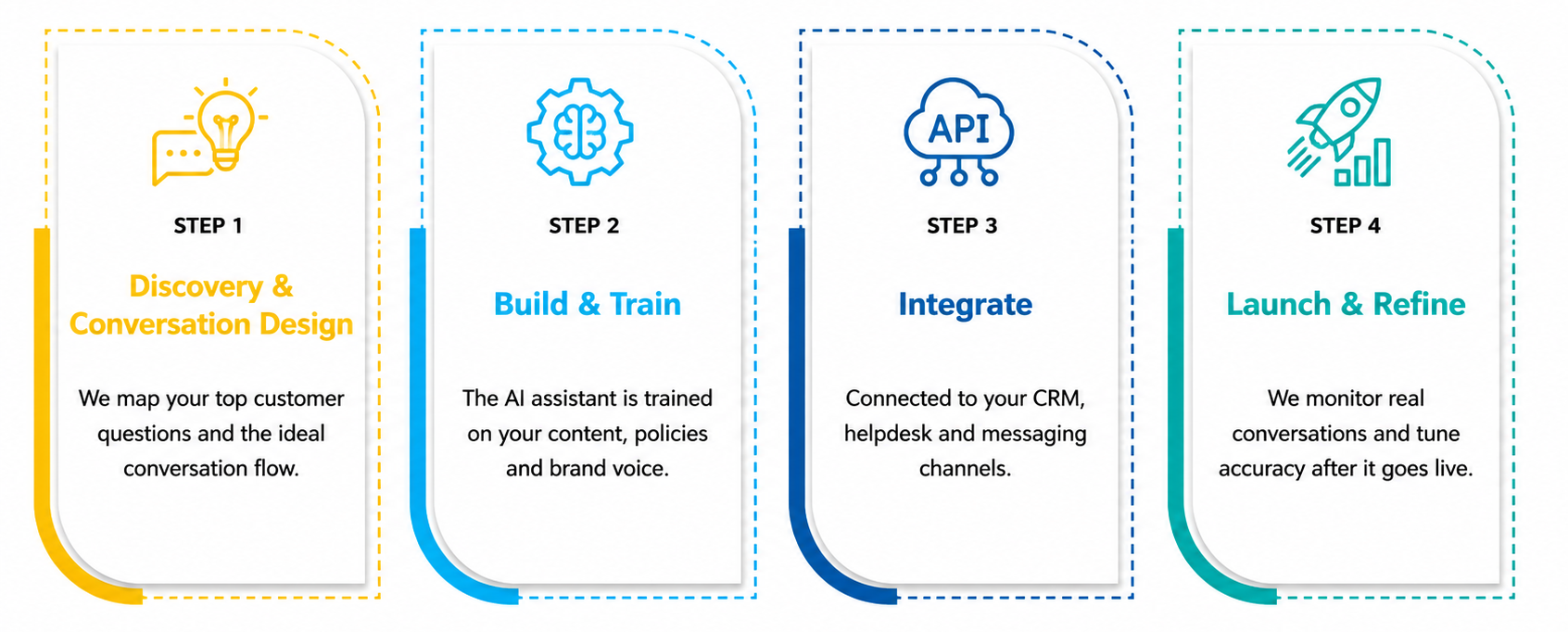
Yes. AI chatbots and virtual AI assistants can connect with CRM, ERP, help desk, E-commerce and other business applications through APIs and integrations. Depending on the permissions provided, the AI can retrieve information or perform specific actions. This allows users to interact with business systems through a conversational interface instead of manually searching across multiple applications.
Can an AI virtual assistant transfer a conversation to a human?
A virtual AI assistant can transfer conversations to human employees when it cannot resolve a request, when a user asks for assistance or when human judgement is required. The handoff can include the conversation history and collected information, allowing the employee to understand the situation without asking the customer to repeat everything.
Can an AI chatbot handle multiple customer conversations at the same time?
Yes. AI chatbots can handle multiple conversations simultaneously without requiring a separate support representative for each user. They can respond to common questions, provide relevant information and guide users through predefined processes at any time. This can help businesses manage high volumes of customer interactions while allowing support teams to focus on more complex or sensitive requests.
Can a virtual AI assistant perform actions instead of only answering questions?
Yes. With the right integrations and permissions, a virtual AI assistant can do more than providing an information. It can retrieve records, create support tickets, update approved information, initiate workflows, schedule appointments or trigger actions in connected systems. Businesses can define which actions the assistant is allowed to perform and which require human approval.
Can businesses start with a small AI chatbot and expand it later?
Yes. Many businesses begin with a focused use case, such as customer FAQs, employee knowledge search or support assistance and expand the solution over time. Additional knowledge sources, integrations, workflows and user groups can be added as requirements grow. Starting with a clearly defined use case also makes it easier to test adoption, measure results and identify improvements before expanding the AI assistant.