Can LLMs integrate with existing ERP or CRM systems?
LLMs can connect with ERP, CRM, helpdesk, inventory and other business applications through APIs and controlled integrations. An AI assistant can retrieve relevant records, answer questions using business data or trigger approved actions. The integration should include authentication, permissions and validation to ensure that the AI only accesses the systems and functions it is authorised to use.
What is the difference between LLM integration and Custom GPT development?
LLM integration adds AI capabilities to an existing application, website, SaaS platform or business workflow. Custom GPT development focuses on configuring an AI assistant for a specific purpose using instructions, knowledge and capabilities. A Custom GPT is useful for specialised AI experiences, while API-based LLM integration provides more control when AI needs to become part of your own software or business application.
Can LLM integration automate business processes?
LLM integration can automate tasks that involve understanding or generating natural language, such as processing emails, summarising documents, classifying requests, extracting information and responding to customer queries. When connected with APIs and workflow automation tools, an AI system can also pass information between applications or trigger approved actions. LLMs are most effective when combined with traditional automation for structured business processes.
How secure are LLM integration services for enterprise applications?
Enterprise LLM integration services can be designed with security controls such as authentication, role-based access, encryption, API security and restricted data access. The AI should only access the information and systems required for its specific purpose. Businesses should also review the data policies of their selected AI provider and implement appropriate monitoring, logging and governance based on their security and compliance requirements.
How do we start an LLM integration or Custom GPT project?
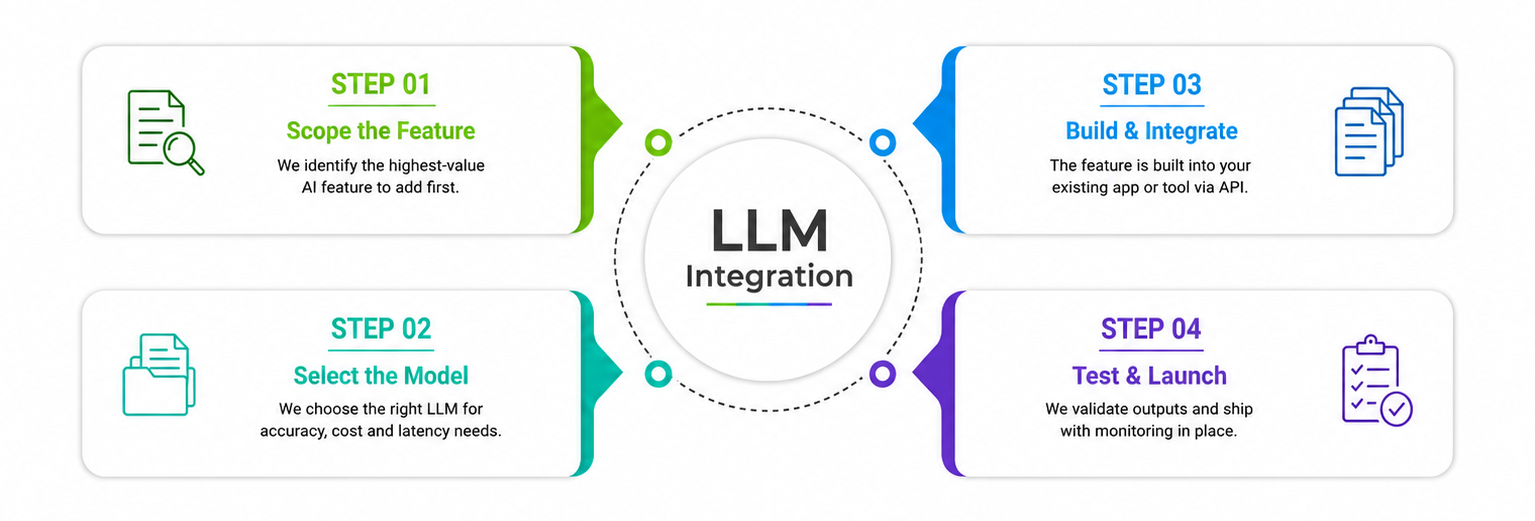
Start by identifying a specific business problem where AI can provide measurable value. Next, assess your data sources, existing software, users, security requirements and desired outcomes. Based on these factors, the right approach can be selected, such as a Custom GPT, API-based LLM integration, RAG solution or AI assistant connected to business systems. A proof of concept can then validate the solution before full development.
What types of business tasks can Custom GPT solutions handle?
Custom GPT solutions can support a wide range of tasks involving business information and natural-language interaction. Common examples include answering employee questions, searching company knowledge, assisting customer support teams, summarising documents, generating reports, explaining policies and helping users find relevant information. When connected to external tools, the assistant can also retrieve live data or trigger approved actions. The actual capabilities depend on the systems, data and permissions provided to the solution.
Can an LLM work with real-time business data?
An LLM can work with real-time or frequently updated information when it is connected to appropriate APIs, databases or business systems. For example, an AI assistant may retrieve current inventory levels, order status, customer information or other live data when a user asks for it. The language model itself does not automatically know your latest business data; the application must securely retrieve the required information and provide it to the model at the time of the request.
Can an LLM solution be integrated with multiple business systems?
An AI solution can connect with multiple systems through APIs and other integration methods, provided each system exposes the required access. For example, an AI assistant may work with a CRM for customer information, an ERP for order data and a knowledge base for company documentation. A central AI interface can then help users access information across these systems. Each integration should have its own authentication, permissions and data access controls.