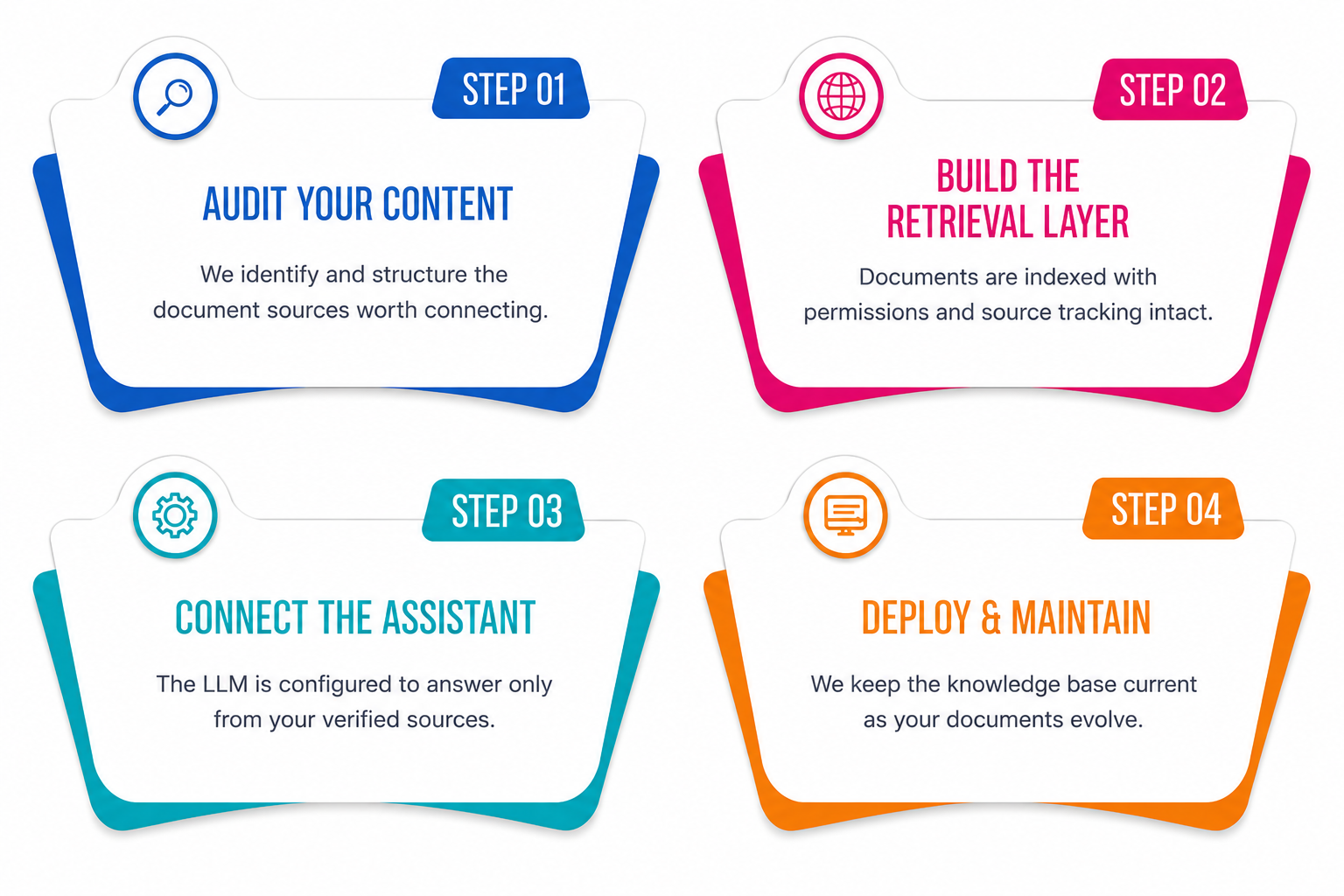
What is an Enterprise RAG Knowledge Assistant?
An Enterprise RAG Knowledge Assistant uses retrieval-augmented generation to help employees find answers from approved company information. It can connect with internal documents, knowledge bases, policies, technical content and other business data sources. Instead of relying only on general AI knowledge assistant, it retrieves relevant enterprise information and uses it to generate more context-aware answers.
What are common use cases for Enterprise Knowledge Assistants?
Enterprise Knowledge Assistants can support internal employee queries, technical documentation, HR policies, IT support, product information, customer support, employee onboarding and operational knowledge. They are particularly useful when information is spread across multiple systems and employees spend significant time searching for documents or repeatedly asking teams for the same information.
How does an Enterprise RAG system handle updated information?
The system can be connected to data pipelines that regularly synchronise and re-index updated content. When documents are changed, added, or removed, the knowledge base can be updated accordingly. Proper metadata and version management also help the retrieval system identify current information and avoid relying on outdated or superseded documents.
Can a Knowledge Assistant show the sources used for its answers?
Yes. An Enterprise Knowledge Assistant can be designed to provide source references alongside its responses. This allows employees to verify where the information came from and review the original document when necessary. Source attribution is particularly valuable for technical, operational, compliance and policy-related questions where users need to validate the information before acting.
How is an Enterprise RAG Assistant different from regular AI chatbots?
Regular AI chatbots generally responds using the knowledge and capabilities of its underlying AI model. An Enterprise RAG system retrieves relevant information from approved company data before generating its response. This makes it more suitable for business-specific questions involving internal policies, processes, products, documentation and proprietary knowledge that general-purpose AI may not know.
Can an Enterprise RAG Assistant answer questions from large document collections?
RAG systems are designed to retrieve relevant information from large collections of documents rather than requiring users to manually search through every file. Documents can be processed, indexed and organized using metadata and other retrieval methods. When a user asks a question, the system identifies relevant content and uses it to generate a response. This makes large knowledge repositories easier to access through natural language queries.
Can an Enterprise RAG solution work with existing knowledge management systems?
An Enterprise RAG solution can be connected to existing knowledge repositories and business systems through suitable connectors or integrations. This allows organizations to make existing information more accessible without necessarily replacing their current systems. The implementation depends on the platform, data format, APIs, authentication methods and security requirements of each source.
Can an Enterprise RAG solution be customized for a specific industry?
The knowledge assistant can be customized to the terminology, documents, workflows and information requirements of a specific industry. For example, a manufacturing business may connect production manuals and SOPs, while a pharmaceutical company may use controlled documentation and operational knowledge. Customization allows the assistant to retrieve information that is relevant to the organization's actual business environment rather than relying on generic knowledge.
Can an Enterprise Knowledge Assistant be integrated with business workflows?
A knowledge assistant can be connected to existing business applications and workflows where appropriate. Beyond answering questions, it may help users find relevant information before completing a task, summarize documents or guide employees through established processes. The exact capabilities depend on the integrations and automation requirements of the organization.