What systems can be connected through software system integration services?
Software system integration can connect ERP, CRM, accounting, E-commerce, payment, inventory, HR, logistics, warehouse and other business applications. It can also connect custom software with third-party platforms, cloud applications and legacy systems. The integration method depends on the systems involved and may include APIs, webhooks, databases, file transfers or middleware. The goal is to allow different applications to exchange data and work together as part of a connected business process.
How does API integration solutions help businesses connect different software systems?
API integration solutions allow different applications to exchange data and perform actions without manual data entry. For example, an E-commerce platform can send new orders to an ERP, while the ERP can return inventory or order status updates. API integration services can connect CRMs, payment gateways, accounting tools, logistics platforms and custom applications. It helps automate data exchange and allows businesses to extend existing software without replacing their entire technology infrastructure.
Can you integrate legacy systems with modern cloud applications?
Yes, legacy systems can often relate to modern cloud applications without replacing the existing software. Depending on the system, integration may use APIs, databases, file transfers, middleware or a custom integration layer. This allows businesses to continue using important legacy applications while connecting them with newer CRM, ERP, E-commerce or cloud platforms. The integration approach depends on the legacy system's architecture, available interfaces and data structure.
How do you keep data synchronized between multiple business applications?
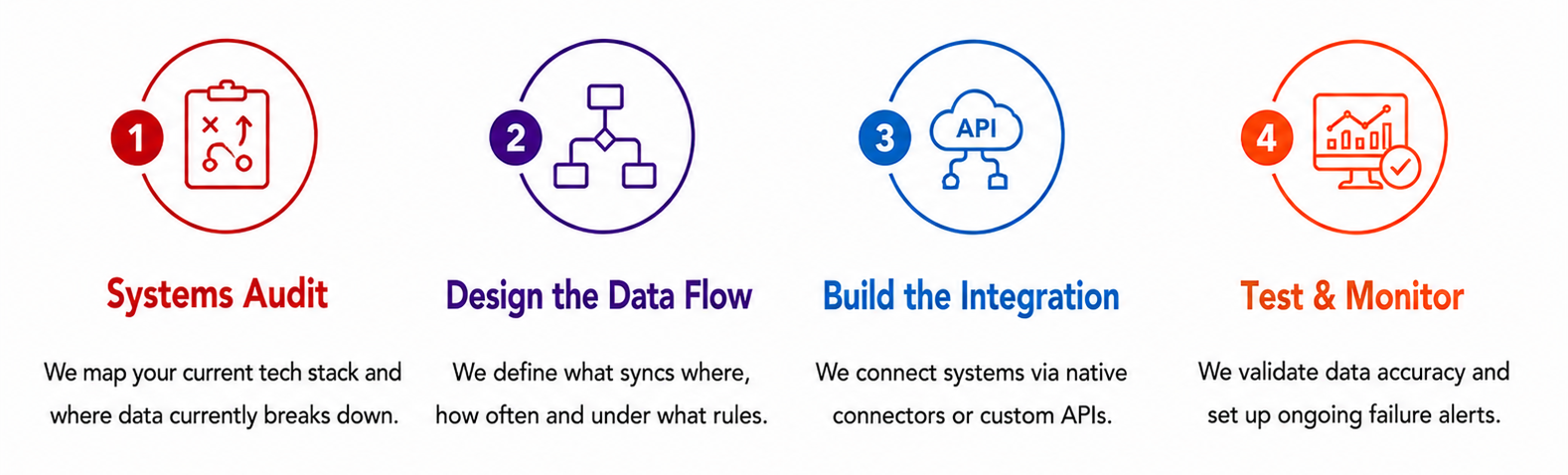
Data synchronization requires defining which system owns specific information and how updates should move between applications. Integration teams map data fields, establish synchronization rules and determine whether information should be updated in real time or at scheduled intervals. Error handling and retry mechanisms help manage failed transactions. Proper synchronization can keep customer, product, order, inventory and other business data consistent across connected applications.
How do you secure data during software system integration?
Integration security involves controlling how applications communicate and what information they can access. Common measures include secure authentication, authorization, encrypted communication, controlled API access, credential management and monitoring. Integration endpoints should expose only the required data and functions. Security testing and monitoring should also continue after deployment to identify potential issues. The exact security controls depend on the systems being connected and the type of data being exchanged.
What are the common challenges in software system integration?
Common challenges include incompatible data formats, poor data quality, outdated legacy systems, limited APIs, authentication issues, duplicate records and inconsistent business processes. API rate limits and system downtime can also interrupt data exchange. These challenges can be reduced through proper technical assessment, data mapping, integration architecture, error handling, testing and monitoring. Each integration should be designed around the specific systems and workflows involved rather than applying the same approach everywhere.
Can AI applications be integrated with existing business systems?
Yes, AI applications can connect with existing business systems to access data, automate tasks and support workflows. For example, an AI assistant can retrieve customer information from a CRM or access order and inventory data from an ERP. APIs are commonly used to connect AI solutions with existing applications. The integration should include appropriate access controls, data security and monitoring to ensure the AI system can only access and use the information required for its intended purpose.
What is the difference between API integration and software system integration?
API integration is one method of connecting software applications, while system integration is a broader process of connecting applications, databases, services and technologies. Software system integration may use APIs along with webhooks, middleware, message queues, databases or file transfers. For example, connecting an ERP and CRM may involve APIs for customer data and scheduled synchronization for other records. API integration is therefore often one part of a complete system integration strategy.